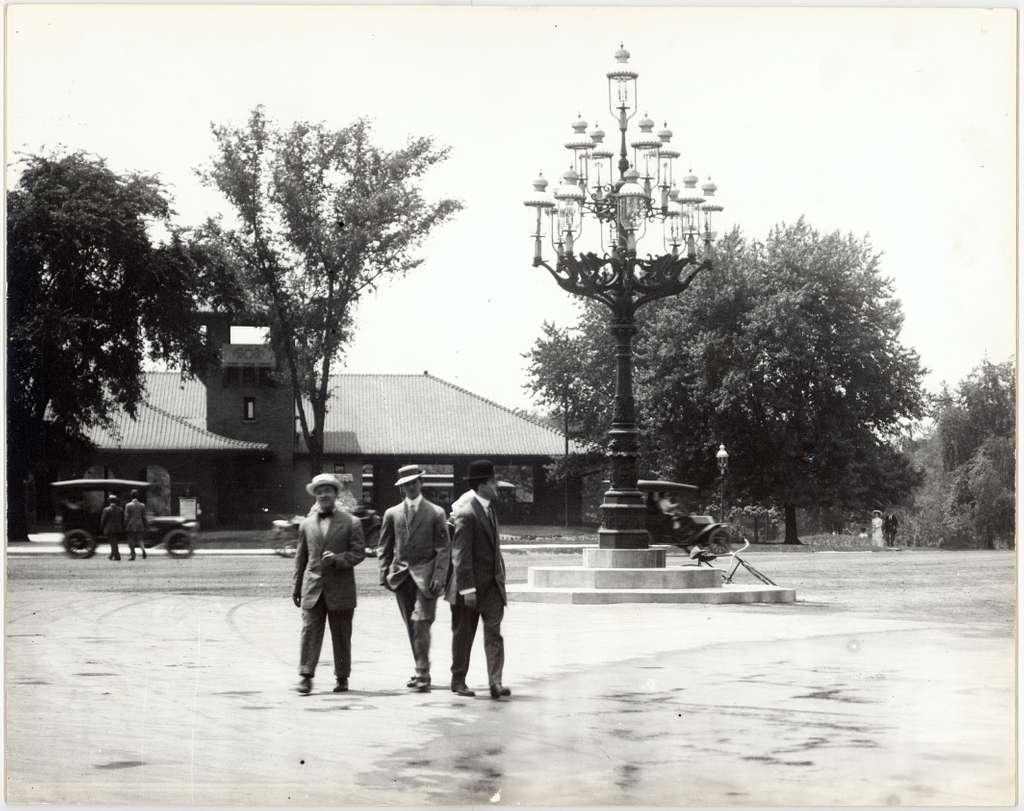
Look at that lamp.
Not the three gentlemen in their boater hats, not the early automobiles blurring past on the left, not the low-slung building that would have been familiar to anyone heading into Forest Park in those years. The lamp. It's enormous — multiple arms branching off a single ornate iron post, each one curving upward to hold a glass globe, the whole thing sitting on a raised stone platform like it knows it owns the intersection.
Which, in a sense, it did.
Five Streets, One Lamp
What you're looking at is not a decorative flourish. It's infrastructure. At the time this photograph was taken, Kingshighway and Lindell didn't meet at a simple four-way intersection the way they do today. There was a fifth road — an additional entrance to Forest Park that has since been closed — making this one of the more complex traffic confluences in the city. Before traffic signals existed, something had to tell drivers and carriage operators where the center of the intersection was, which lanes belonged to which street, and how to navigate around the whole thing without catastrophe.
The lamp solved that problem magnificently. Placed on a raised stone platform in the middle of the confluence, tall enough to be visible from all five approaches, it turned a potentially chaotic intersection into an organized roundabout. You drove around the lamp. The lamp was the rule.
"The city once built its infrastructure to be magnificent. This is the evidence."
This was not unusual thinking for St. Louis at the time. The city in the late 19th century was the fourth largest in the United States, flush with Gilded Age wealth, and it had opinions about what a great city should look like. Beautiful public infrastructure wasn't a contradiction in terms — it was a point of civic pride. The lamp at Kingshighway and Lindell wasn't just doing a job. It was doing the job beautifully, in a way that announced something about the neighborhood it stood in and the city that built it.
When the Intersection Changed
At some point, the extra Forest Park entrance was closed. The logic was straightforward: a standard four-way intersection is simpler, safer, and easier to manage with the traffic signals that were becoming common by the early 20th century. The fifth road disappeared, the geometry simplified, and the lamp — that magnificent, over-engineered, utterly spectacular lamp — no longer had a reason to exist.
It came down. St. Louis, like most American cities in the 20th century, was moving fast and shedding things that didn't fit the new pace. The lamp was one of them.
The Resurrection It Almost Got
Here's where the story gets interesting again. In the 1970s, when Maryland Plaza was redesigned and pedestrianized as part of a broader effort to revitalize the Central West End, someone remembered. The candelabra streetlamps that line Maryland Plaza today — the ones that have become so synonymous with the neighborhood that visitors photograph them on every visit — were designed with that original Kingshighway lamp in mind. Not an exact replica, but a conscious echo. A revival of the aesthetic language of a lamp that the city had lost and apparently never quite gotten over.
The Maryland Plaza lamps don't do what the original did. They're not directing traffic around a five-way intersection or standing on a raised stone platform in the middle of a confluence of roads. They're ornamental. But they carry the memory of something that was both functional and beautiful, and in a neighborhood that has spent decades trying to reconnect with what made it great, that lineage matters.
And Then There's the Logo
Our logo is modeled on the Maryland Plaza lamps. Which means it's modeled, at one remove, on the lamp in this photograph. Which means every time you see the TourCWE candelabra, you're looking at an echo of an echo — a Gilded Age piece of working infrastructure that the city lost, tried to remember, and is still, in small ways, honoring.
That feels right for a tour that's fundamentally about the layers of this neighborhood. The CWE doesn't have one history. It has a dozen, stacked on top of each other, each one leaving traces in the streetscape for anyone who knows how to read them. The lamp at Kingshighway and Lindell is one of those traces — gone but not entirely, visible if you know where to look.
"A Gilded Age piece of working infrastructure that the city lost, tried to remember, and is still, in small ways, honoring."
On the tour, we walk right past the Maryland Plaza lamps. Most people admire them without knowing what they're looking at. Now you do.
The Tour That Tells Stories Like This One
On our Food + History walking tour of the Central West End, we walk past the Maryland Plaza lamps, the former sites of Gilded Age mansions, and the places where St. Louis zigged when it should have zagged — all while eating very well. Join us.
Book the Food Tour →